
EEO Bystander Training in 2026: A Practical Guide to Workplace Intervention

Why Bystander Training Is a Workplace Essential
Here’s an uncomfortable truth: most employees who witness workplace harassment never step in. It’s rarely because they don’t care. They’re unsure how to respond safely, worried about getting it wrong, or assuming a colleague or manager will act first. Targets are left unsupported, harmful behavior gets normalized, and the cost lands on culture, retention, and legal exposure. Structured bystander training closes that gap.
What is bystander training?
Bystander training is workplace education that teaches employees how to recognize harmful behavior and respond safely when they witness it. The goal is to shift employees from passive observers to active upstanders who can interrupt harassment, support targets, and document incidents without escalating risk.
Most programs cover:
- Harassment, discrimination, and bullying
- Microaggressions and biased jokes or comments
- Intimidation and disrespectful conduct
- Safe response strategies — commonly the 5Ds: Distract, Delegate, Document, Delay, Direct
The cost of silence is real. When peers stay quiet, the offender hears permission. The target hears confirmation that the workplace won’t protect them. Over time, this pattern erodes trust, drives attrition, and builds the documented liability that fuels harassment claims. These aren’t rare moments they expose a larger gap in how organizations respond to harm as it happens.
Bystander training closes this gap by giving employees a structured playbook for what to do in the moment. The most-used framework the 5Ds, developed by Right To Be gives five distinct response options that match different risk levels and personality types (covered in detail below). For HR leaders and business owners, the result is shared accountability, stronger culture signals, and a defensible record of proactive harassment prevention.
This guide covers the practical mechanics of EEO bystander training, the psychological barriers that keep people frozen, and the response frameworks that work in real workplaces. For instructor-led training built around your industry and risk profile, see our EEO Compliance Training Services.
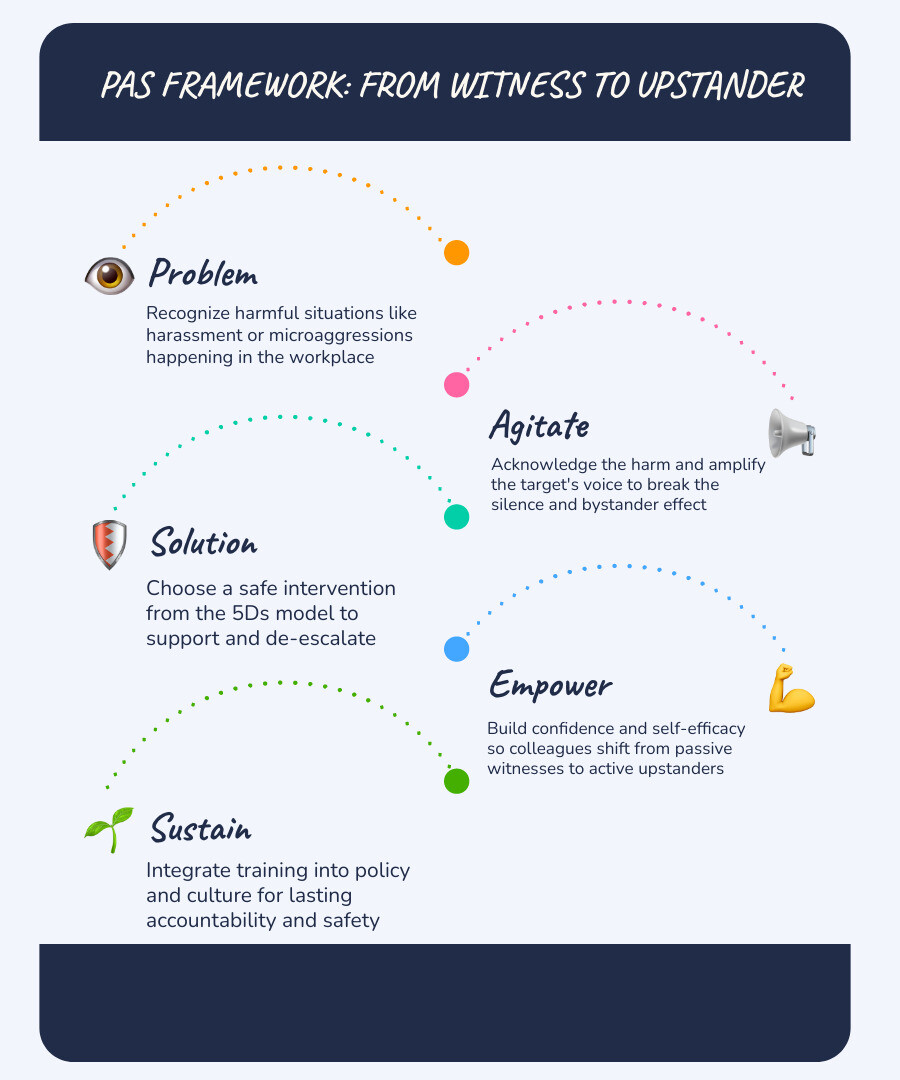
The Psychology of Inaction: Why We Need Bystander Training

Building a safer workplace starts with understanding why people stay silent. Workplace safety depends on shared accountability every employee acting as part of the response system, not just HR. When toxic behavior goes unchecked, the signal it sends spreads faster than any policy document can correct.
Without proactive intervention, microaggressions, bias, and bullying can escalate into severe harassment or even violence. This is why modern compliance strategies have shifted from passive “check-the-box” policies to active, skills-based anti-harassment programs that empower the entire workforce to act.
Bystander vs. Upstander: Shifting the Workplace Paradigm
Bystander training redefines two roles:
- Bystander: Someone who witnesses discrimination, harassment, or violence but stays passive.
- Upstander: Someone who recognizes harm and acts interrupting, redirecting, defusing, or reporting.
When passive bystanders do nothing, they can unknowingly signal to the offender that their behavior is acceptable, which further isolates the target. Shifting behavior from bystander to upstander is the ultimate goal of active allyship. By training our teams to recognize their collective power, we transform the workforce from a collection of silent observers into an active network of mutual support. This cultural shift is backed by extensive scientific research on bystander intervention, which demonstrates that structured education significantly increases an individual’s self-efficacy and willingness to help.
Overcoming the Bystander Effect and Social Barriers
The Bystander Effect, first documented by social psychologists Darley and Latané in 1968 describes a counterintuitive finding: the more people who witness an emergency, the less likely any single person is to help. Three psychological barriers drive the freeze:
- Diffusion of responsibility: Assuming someone else will step in.
- Pluralistic ignorance: Reading the room if no one else looks alarmed, the situation must not be serious.
- Evaluation apprehension: Fearing social judgment or being wrong about what just happened.
In the workplace, these barriers stack with industry-specific hurdles: fear of retaliation, concern about damaging professional relationships, unclear policy definitions, and power imbalances with senior offenders.
Effective training breaks the freeze by building three things self-efficacy (confidence in knowing what to do), empathy for the target, and visible social norms that reward speaking up instead of penalizing it.
Implementing Bystander Intervention: Frameworks, Safety, and Culture

Empowering employees to act is only half the battle; they must also know how to act safely and constructively. Effective intervention relies on structured de-escalation strategies and clear behavioral frameworks that ensure policy compliance while keeping employees safe. For organizations looking to build comprehensive safety nets, combining these intervention models with robust violence prevention programs is the key to minimizing organizational risk.
The Core Frameworks of Bystander Training
The most widely used bystander intervention framework is the 5Ds model, developed by Right To Be (formerly Hollaback!). It gives employees five distinct response options, so every person can find a method that fits their comfort level, position, and read of the safety situation:
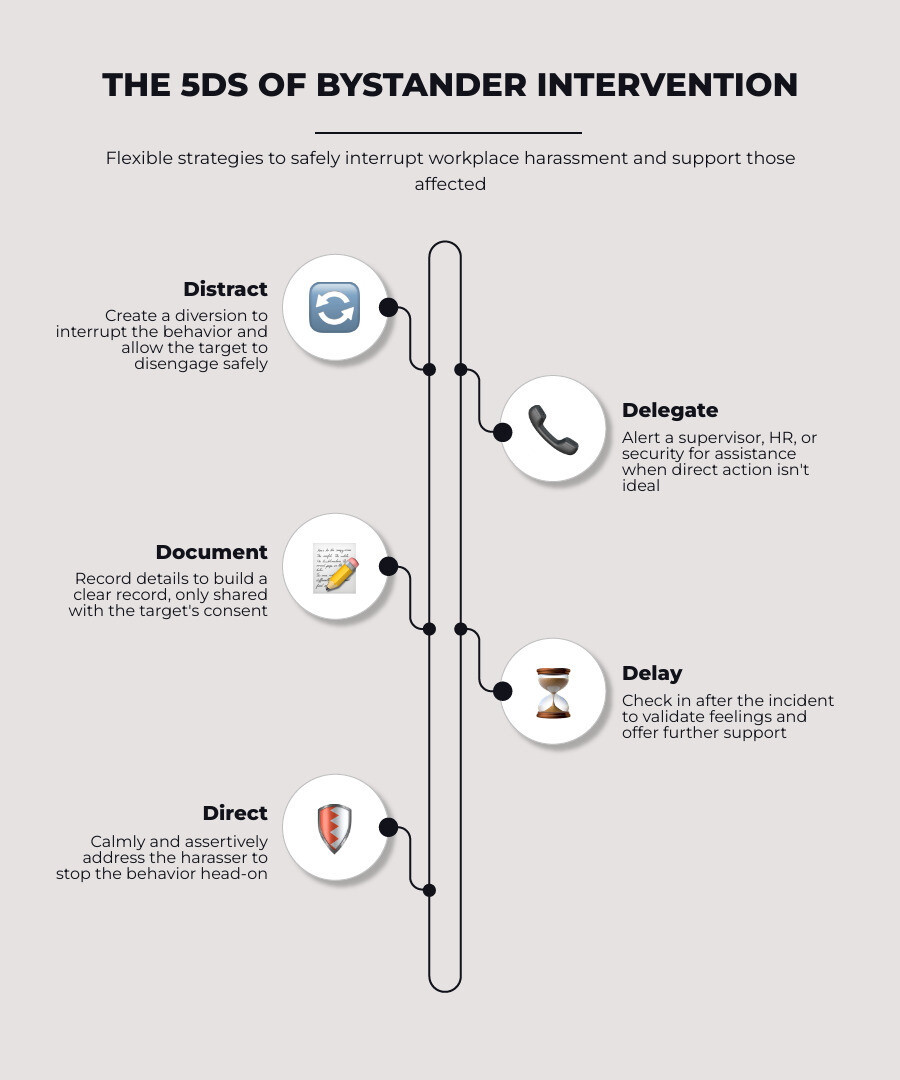
- Distract: Interrupt indirectly by creating a diversion. Ask the target an unrelated question, pretend to need directions, or drop something to break the moment and give the target an exit.
- Delegate: Hand off to someone with more authority or better resources — HR, a supervisor, security, or a building manager.
- Document: Record or note what’s happening. Useful for building a record, but share documentation only with the target’s consent. Their agency comes first.
- Delay: Check in with the target after the incident. Ask if they’re okay, validate their experience, and offer to help them report if they want to.
- Direct: Address the behavior head-on, speaking calmly and assertively to the person causing harm. Use only when the safety read is clear.
Some organizations also utilize the 4Ds model (Direct, Distract, Delegate, Delay), which compresses these options while retaining the same foundational principles. Both frameworks are supported by rigorous scientific research on the 5Ds, proving that indirect methods (like Distract and Delay) are incredibly powerful at de-escalating conflicts without escalating the risk of physical confrontation.
Real-World Scenarios: From Microaggressions to Harassment
Bystander intervention is not reserved solely for extreme emergencies; it is highly applicable to everyday workplace friction:
- Sexist or Racially Biased Jokes: An upstander might use a Direct approach by saying, “I don’t get it, can you explain why that’s funny?” or a Delay approach by checking in with a colleague who looked visibly uncomfortable.
- Microaggressions in Meetings: If a colleague is repeatedly interrupted or has their ideas co-opted, an upstander can Distract or redirect: “I’d love to hear Sarah finish her thought on the budget before we move on.”
- Ambient Sexual Harassment: Simply overhearing inappropriate comments about a coworker’s appearance can degrade workplace morale. Active bystanders recognize that addressing these subtle norm breaches protects everyone’s psychological safety.
Prioritizing Safety: When and How to Intervene
Personal safety comes first. Every intervention starts with a rapid read of the situation:
- Is there a risk of physical violence?
- Are weapons present or visible?
- Am I outnumbered, isolated, or cornered?
If the situation has crossed into violence or is heading there, confrontation is the wrong move. Delegate immediately — call security or 911. De-escalation always means lowering the room’s temperature, never matching the aggressor’s energy.
Key Takeaways: Implementing Effective Workplace Intervention
- Use a real framework: The 5Ds (Distract, Delegate, Document, Delay, Direct) give employees five response options matched to different comfort and safety levels — no one has to be the hero.
- Break Psychological Barriers: Overcome the bystander effect, specifically diffusion of responsibility and pluralistic ignorance, by establishing clear cultural norms that reward supportive behaviour.
- Safety first, always: Programs must teach a rapid safety read before any confrontation. Indirect methods (Distract, Delay) carry the lowest risk and the highest success rate.
- Build culture, not compliance theatre: Check-the-box training doesn’t change behaviour. Scenario-based, interactive programs do.
Navigating evolving state and local training requirements shouldn’t feel like a defensive compliance exercise. Discover how our scenario-based, interactive programs turn passive workforces into active allies while satisfying legal benchmarks. Contact us today to learn how we can help protect your organization and transform your workplace culture.
