
Navigating the Maze: Sexual Harassment Training Requirements all 50 States
Introduction
Sexual harassment training requirements all 50 states are not governed by one uniform rule. Federal law does not expressly require private employers to provide employee training, but state and local requirements vary significantly. California, Connecticut, Delaware, Illinois, Maine, New York, and Washington impose statutory obligations with distinct employer-size thresholds, renewal cycles, and curriculum standards; New York City and Chicago add important local mandates. In every other jurisdiction, regular anti-harassment training remains a prudent way to strengthen prevention efforts, support a respectful culture, and help preserve available legal defenses.
Managing a distributed workforce across these different jurisdictions creates real compliance challenges. For business owners, HR leaders, and C-suite executives, failing to deliver compliant training does more than trigger administrative audits and financial penalties; it leaves your organization vulnerable to costly harassment claims and weakened legal defenses.
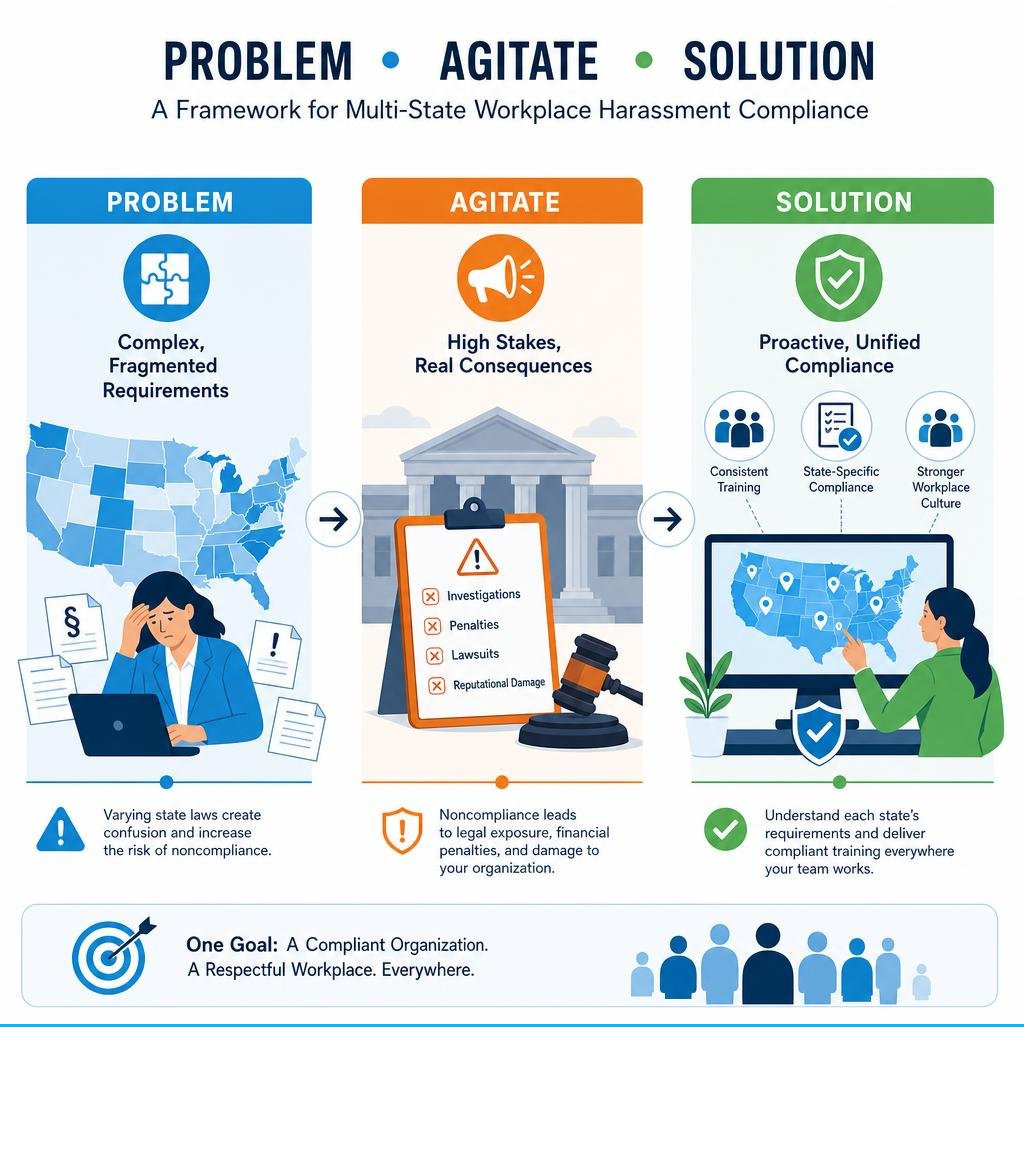
The solution is straightforward: establish a proactive, unified compliance framework. By understanding the specific legal thresholds in every jurisdiction where your team works, you can replace regulatory confusion with seamless compliance and a healthier workplace culture.
Understanding Sexual Harassment Training Requirements All 50 States

While federal law—primarily Title VII of the Civil Rights Act of 1964—prohibits workplace sexual harassment across the country, it does not explicitly mandate employee training. Instead, state and local governments have created their own requirements. As of September 2026, state standards fall into two broad categories: jurisdictions with explicit statutory mandates for private employers, and jurisdictions that strongly encourage training to satisfy affirmative defense legal standards.
Understanding employee thresholds, renewal cycles, and required content is essential to keep your organization fully compliant.
For a broader state-by-state reference, consult Project WHEN’s harassment training requirements guide alongside the applicable state and local agency guidance.
| State / Jurisdiction | Employer Size Threshold | Required Frequency | Minimum Training Duration | New-Hire Deadline |
|---|---|---|---|---|
| California | 5+ employees | Every 2 years | 1 hr (nonsupervisors) / 2 hrs (supervisors) | Within 6 months of hire or promotion |
| Connecticut | 3+ employees | Every 10 years (supplemental) | 2 hours (all employees) | Within 6 months of hire |
| Delaware | 50+ employees | Every 2 years | Interactive (effective duration) | Within 1 year of hire |
| Illinois | 1+ employees | Annually | 1 hour minimum | Within calendar year |
| Maine | 15+ employees | Annual tracking / New hires | Comprehensive education | Within 1 year of hire |
| New York State | 1+ employees | Annually | Interactive model standard | As soon as possible / annually |
| Washington | Specific industries (hospitality, retail, security) | Regular intervals | Industry-specific isolated worker training | Prior to working isolated shifts |
| New York City | 15+ employees | Annually | Comprehensive interactive module | Within 90 days of hire |
| Chicago (IL) | 1+ employees | Annually | 1 hr harassment + 1 hr bystander (2 hrs for supervisors) | Within calendar year |
Mandatory Sexual Harassment Training Requirements All 50 States: State-by-State Rules
Several states require private employers to provide anti-harassment training under specific statutory conditions. The following overview of sexual harassment training requirements all 50 states helps multi-state employers identify where a mandatory program, refresh cycle, or industry-specific rule applies.
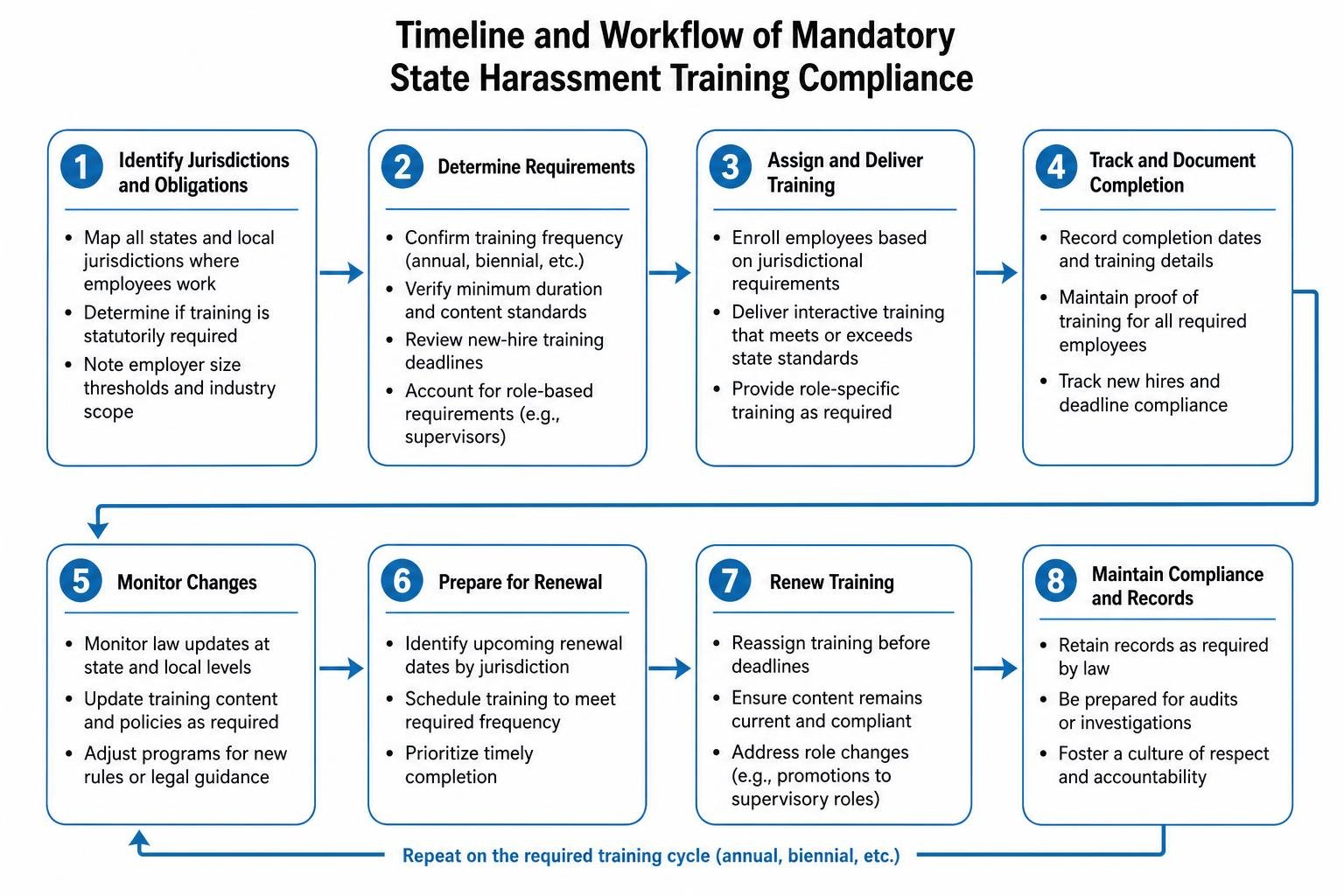
1. California
Under Government Code Section 12950.1 (expanded by SB 1343), private employers with five or more employees (including temporary and seasonal workers) must deliver interactive prevention training. Nonsupervisory employees must complete at least one hour of training every two years, while supervisors must complete two hours every two years. Training must take place within six months of hire or promotion to a supervisory role. Seasonal and temporary staff hired for less than six months must be trained within 30 calendar days of hire or 100 hours worked. The curriculum must cover abusive conduct prevention, sexual orientation, gender identity, and gender expression, aligned with California Civil Rights Department guidelines. Additionally, if 10 percent or more of your workforce speaks a language other than English, policies and materials must be translated accordingly. For specialized state modules, review our sexual harassment training in California.
2. New York State
Under New York State Labor Law Section 201-g, all employers with one or more employees must provide interactive training annually. The training must meet or exceed the state’s model standards, include definitions and examples of unlawful behavior, detail statutory provisions and complaint avenues, and clearly explain employee rights and remedies. Check out our dedicated New York sexual harassment prevention training for compliant statewide delivery.
3. Illinois
The Illinois Workplace Transparency Act mandates that all employers with one or more workers deliver annual sexual harassment prevention training. In addition to the baseline curriculum, restaurants and bars must provide supplemental training tailored to the hospitality industry. Employers failing to comply face tiered civil penalties ranging from $500 for small businesses up to $5,000 for repeated violations. Access our Illinois annual training requirements module for complete coverage.
4. Connecticut
Under the Time’s Up Act, employers with three or more employees must provide two hours of training to all staff. Employers with fewer than three workers must provide two hours to supervisors. Training must occur within six months of hire, and employers must provide supplemental refresher courses at least once every ten years. Access our course for sexual harassment training in Connecticut.
5. Delaware
Delaware law requires employers with 50 or more employees to provide interactive anti-harassment education. Training must be completed within one year of employment and refreshed every two years. Supervisors must receive additional training regarding their specific responsibilities to address complaints and prevent retaliation. Explore our options for sexual harassment training in Delaware.
6. Maine
Maine mandates that employers with 15 or more workers conduct workplace training for all new hires within one year of starting work. Supervisory employees must receive specialized guidance on reporting obligations and addressing grievances within the same timeframe. Penalties range from $1,000 for an initial violation up to $5,000 for subsequent offenses. We cover these guidelines in our sexual harassment training in Maine.
7. Washington
Washington targets isolated workers across specific sectors, including hospitality hotels and motels, retail, security guard agencies, and property service contractors. Covered employers must provide specialized harassment and assault prevention training and supply panic buttons to isolated staff. Learn more about our program for sexual harassment training in Washington.
Recommended Sexual Harassment Training Requirements All 50 States and Affirmative Defense Standards
In states without explicit statutory mandates—such as sexual harassment training in Texas, sexual harassment training in Florida, sexual harassment training in Pennsylvania, and sexual harassment training in Ohio—training remains an essential legal protection.
Under the federal Faragher-Ellerth affirmative defense framework established by the U.S. Supreme Court, an employer can avoid or reduce liability for supervisory harassment if it proves two elements:
- The employer exercised reasonable care to prevent and promptly correct any harassing behavior.
- The employee unreasonably failed to take advantage of preventive or corrective opportunities provided by the employer.
Conducting regular anti-discrimination and harassment training proves that your organization takes proactive steps to stop unlawful conduct. Beyond mitigating liability, voluntary training reinforces behavioral expectations, boosts workplace morale, and prevents organizational disruption.
Local City Ordinances: New York City and Chicago Training Mandates
Municipal regulations can impose stricter standards than state laws. Multi-state employers must account for these city-specific rules:
- New York City (Stop Sexual Harassment in NYC Act): Applies to employers with 15 or more workers, including independent contractors who have worked over 90 days and 80 hours in a calendar year. Training must be annual, interactive, and include specific content on bystander intervention training and complaint processes with the NYC Commission on Human Rights.
- Chicago (Chicago Human Rights Ordinance): Requires all employers licensed in Chicago to deliver annual training: at least one hour of general prevention training for all employees, one additional hour of prevention training for supervisors, and one hour of standalone bystander intervention training for all employees annually.
Core Curriculum Standards, Supervisor Obligations, and Record-Keeping
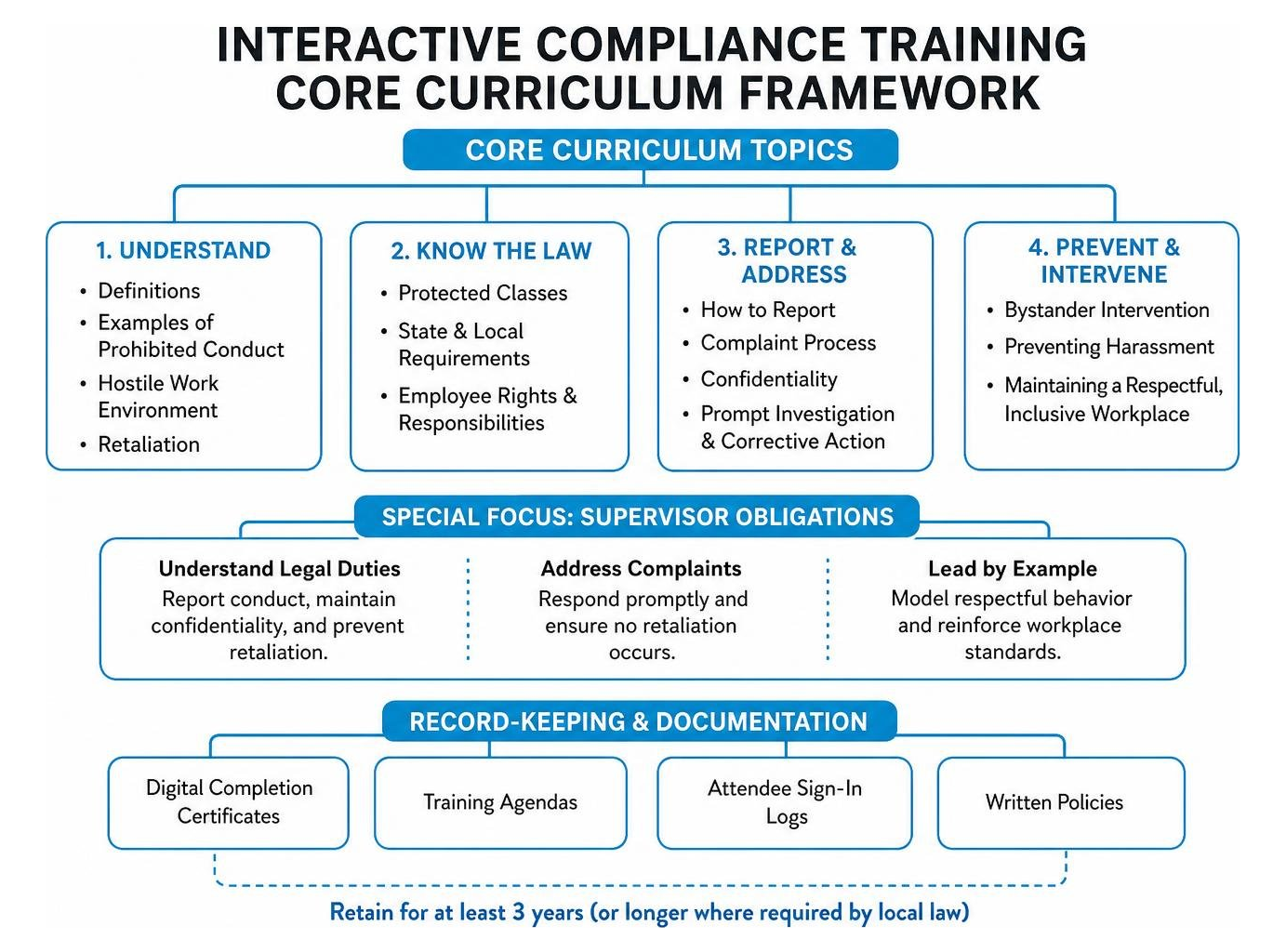
A legally sound training program should cover clear definitions, practical examples, protected classes, and administrative procedures.
Key training and documentation practices include:
- Interactive Scenarios: Use engaging real-world scenarios to help employees identify unlawful behaviors, hostile work environments, and retaliatory conduct.
- Supervisor Responsibilities: Managers must understand their legal obligation to report conduct, maintain confidentiality, and prevent retaliation.
- Record Retention: Maintain digital completion certificates, training agendas, attendee sign-in logs, and written policies for at least three years or longer where local laws require.
Building a Comprehensive Multi-State Compliance Strategy
Managing compliance across multiple jurisdictions requires an experienced training partner and a reliable, modern delivery system. For employers navigating sexual harassment training requirements all 50 states, EEO Training LLC provides online workplace compliance training focused on anti-harassment, anti-discrimination, workplace violence prevention, and related workplace conduct programs. Because harassment and discrimination training is the core of what we do, our team routinely monitors legislation across the United States to help organizations meet federal, state, and local compliance expectations.
Why Use EEO Training?
EEO Training Co-Founder Andrew Botwin brings more than 30 years of experience working with companies, including extensive human resources expertise, workplace complaint investigations, and professional training. This experience helped shape EEO Training’s legal training programs and its use of state-of-the-art technology to deliver anti-discrimination and anti-sexual harassment training.
EEO Training LLC is laser-focused on issues of harassment and discrimination in the workplace. Our courses use 100% original video content and animated character-based vignettes to create a more engaging learning experience than static, check-the-box training. For HR leaders and business owners managing distributed teams, our easy-to-use administrative dashboard and learning management system supports on-demand client reporting, employee updates, and client customizations.
We also pride ourselves on responsive, quality customer service. From single-state requirements to complex multi-state compliance programs, EEO Training LLC helps organizations deliver practical, legally informed training that supports a respectful workplace culture.
To explore practical ways to manage your workforce, review our multi-state compliance guide and our dedicated learning management system. For broader risk-management programs, see our workplace violence prevention training.
Best Practices for Remote Workforces and Leadership-Driven Compliance
To manage a remote or hybrid workforce effectively:
- Adopt the Highest Common Standard: Train your entire workforce using a curriculum that satisfies the strictest state regulations, such as California, New York, and Chicago. This ensures broad compliance and provides a consistent standard of behavior across teams. Partner with EEO Training to customize training to meet your employees state guidelines.
- Automate Tracking: Use an LMS to assign courses automatically during onboarding and flag biennial or annual refresher deadlines.
- Lead from the Top: Real workplace transformation happens when executive leaders actively champion respect and accountability.
To modernize your training framework and protect your organization, review our pricing options and contact our compliance team today. Visit our comprehensive portal on sexual harassment training requirements all 50 states to get started.
